I am staring inert but unblinking into the gaping maw of late-stage capitalism.
If you keep up with the news in any way, you probably have a lot of anxiety about the state of our planet. This is a post about one of the industrial revolution’s more frightening consequences: fast fashion.
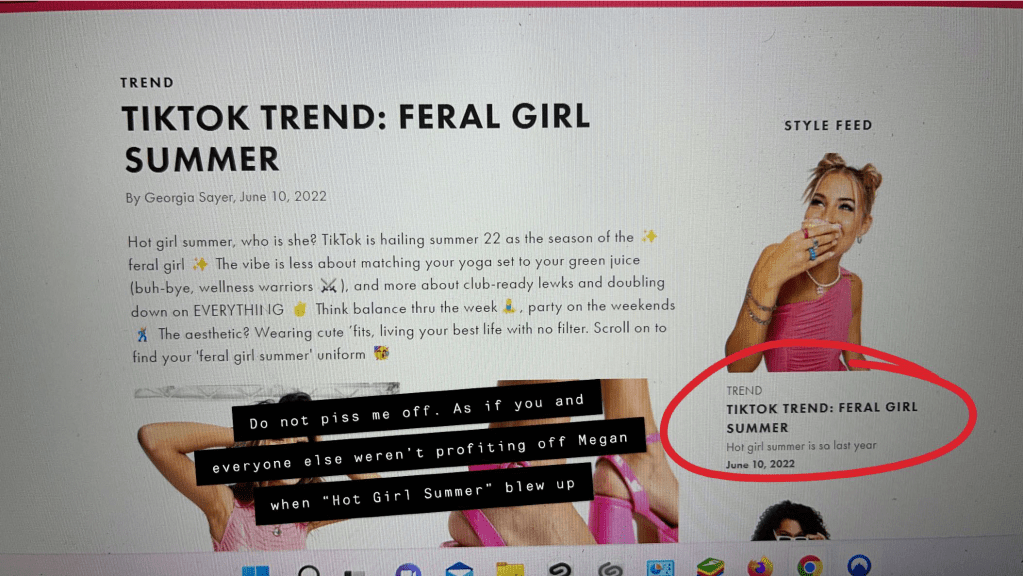
I was in a wedding recently and I was shopping on ASOS (where the bridesmaids were supposed to buy our shoes) and I saw this article; apparently ASOS has a flourishing journalistic community, who knew?
In the spirit of transparency, I saw this article and wrote this script in the summer — late June most likely. And it feels like it could’ve been yesterday, but I come to you bearing this message in winter of 2023.
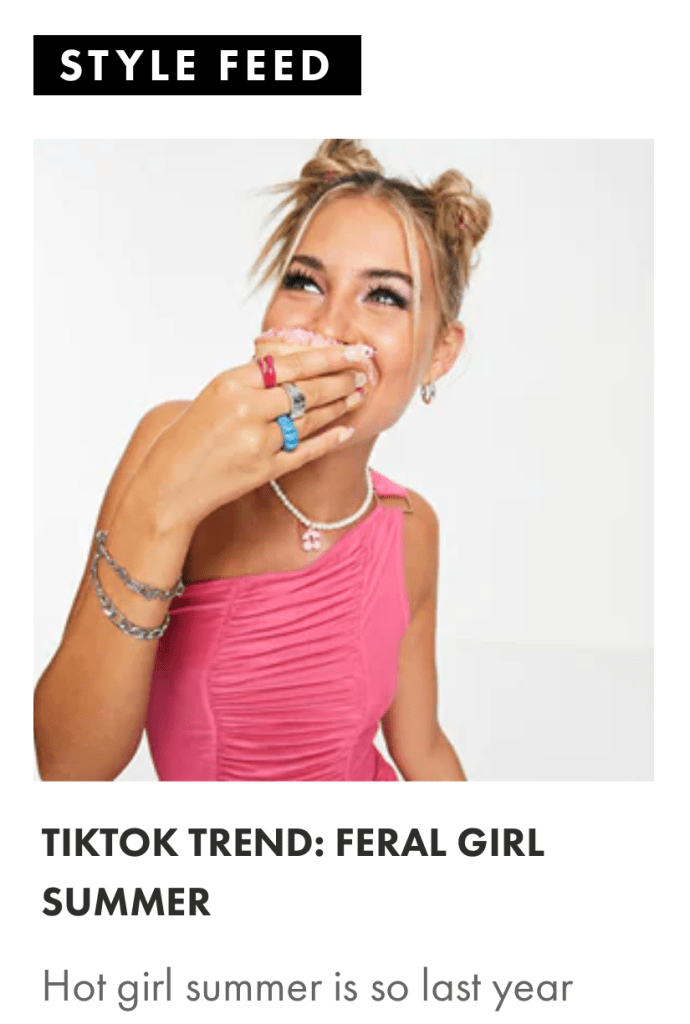
Anyway, the preview I saw (that got me to click) was captioned, “Hot girl summer is so last year.” The first paragraph reads, “Hot girl summer, who is she? TikTok is hailing summer 22 as the season of the ✨ feral girl ✨ The vibe is less about matching your yoga set to your green juice (buh-bye, wellness warriors ⚔️), and more about club-ready lewks and doubling down on EVERYTHING ✌️ Think balance thru the week🧘♀️, party on the weekends 🕺 The aesthetic? Wearing cute ’fits, living your best life with no filter. Scroll on to find your ‘feral girl summer’ uniform 🥳”
I thought to myself, why say this? When I am certain you, like everyone else, capitalized on this phrase that Megan thee Stallion coined.
Like I said, that’s only the first paragraph, so here is the article if you wanna read the whole thing, but the rest is just shilling specific ASOS products, loosely connecting them to this concept of a feral girl summer.
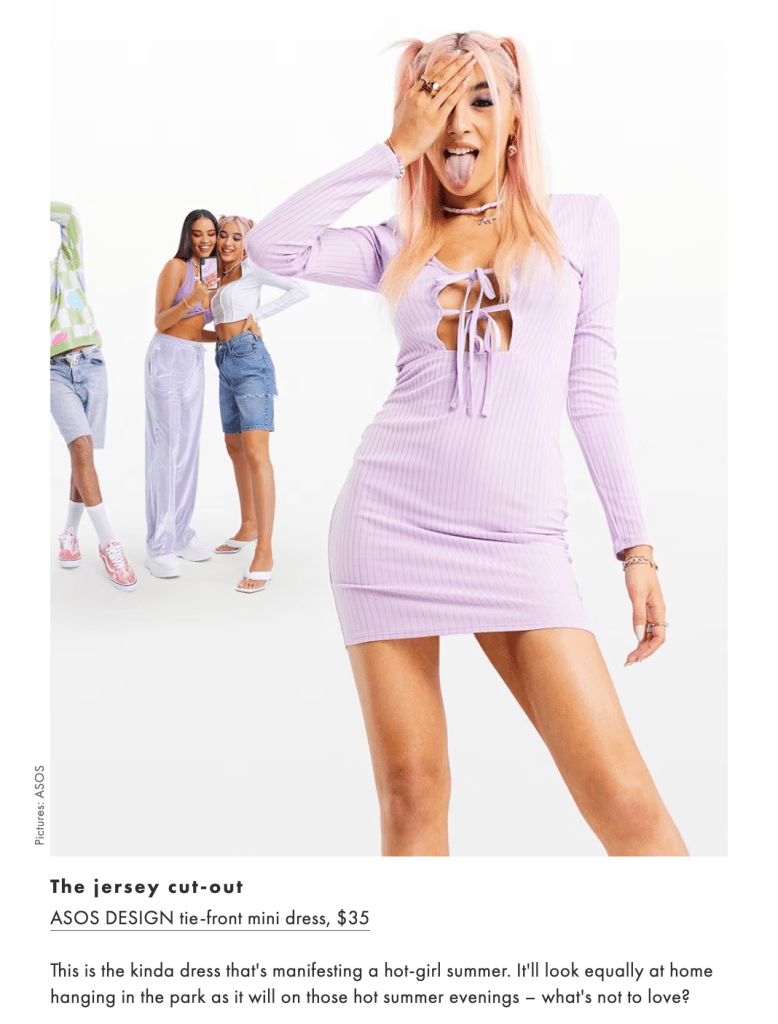
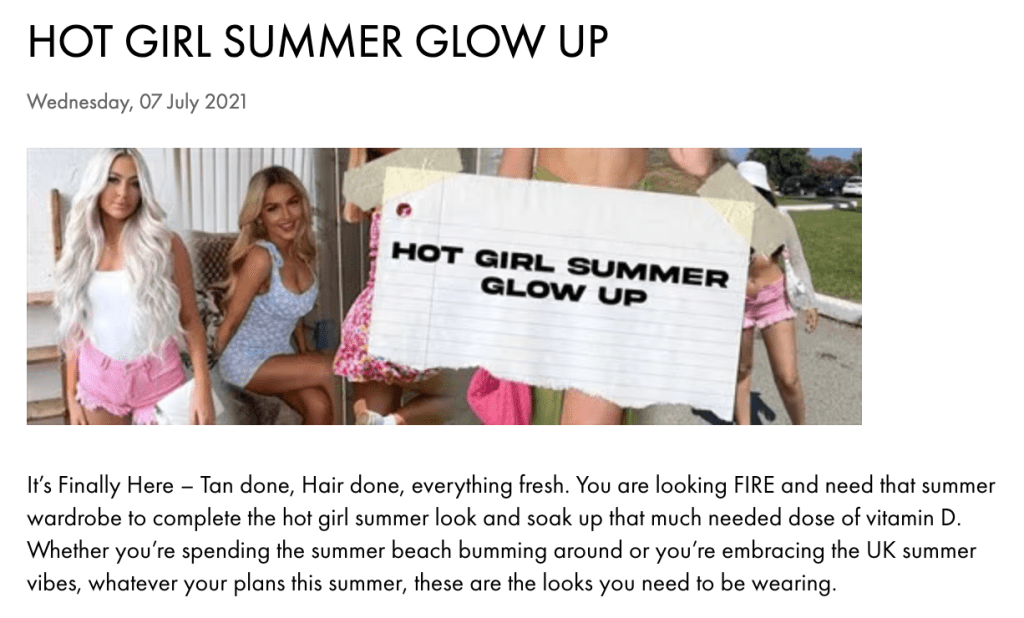
To prove my point about ASOS switching up, I googled “ASOS ‘hot girl summer’” and this article comes up along with two other pieces from ASOS. One from June of 2021 called Top 5 Summer Dress Trends reads, “The jersey cut-out. ASOS DESIGN tie-front mini dress, $35. This is the kinda dress that’s manifesting a hot-girl summer.” Another from July 2021 is called Hot Girl Summer Glow Up. “You are looking FIRE and need that summer wardrobe to complete the hot girl summer look and soak up that much needed dose of vitamin D.” Could be a double entendre, but I’m choosing to ignore that possibility.
So in at least two other pieces of writing, ASOS was capitalizing on Hot Girl Summer by using it to sell their clothes. Which, fine. I don’t blame them. Because everyone has been talking about hot girl summer because Megan is a marketing genius. But to then turn around and publish something saying hot girl summer is so last year, who is she? What a slap in the face to someone who probably moved a lot of product for you without seeing a dime. And in favor of just a derivative of that phrase? [Blank] girl summer at this point is just a spin on what Meg has already established. Y’all will do this until the end of time with what Black women create.
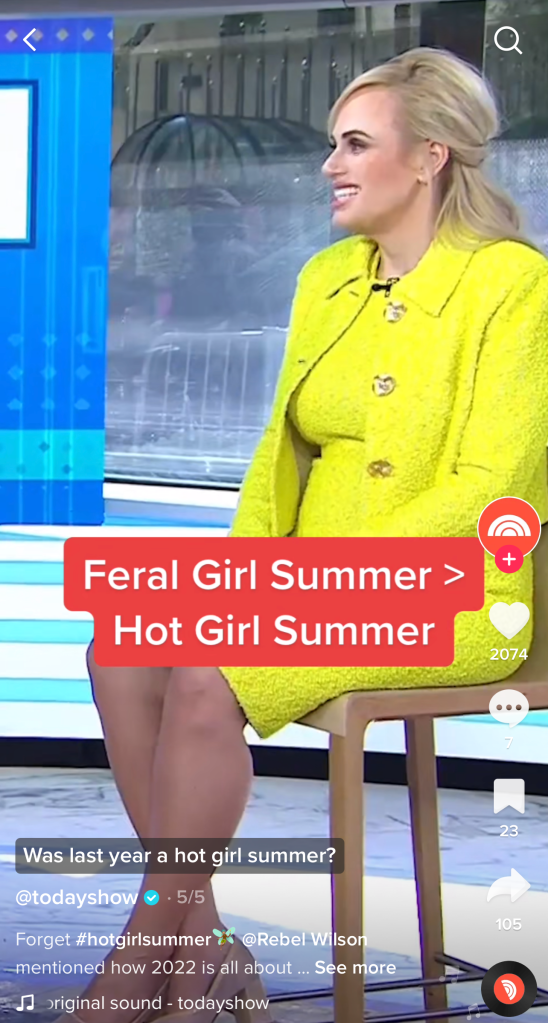
And to be clear, it’s not just ASOS doing this, though they were the first ones I saw. This “feral girl summer” business was taking off on TikTok. The Today Show posted about it. I guess who I’m really mad at is white women.
Today Show, how could you?
This one goes out to Nasty Gal. I got an email that Nasty Gal was having a 60% off sale for dresses and shoes, with an additional 20% off with a code. Why am I on Nasty Gal’s mailing list? It’s personal. It’s actually quite inappropriate that you would ask me that.
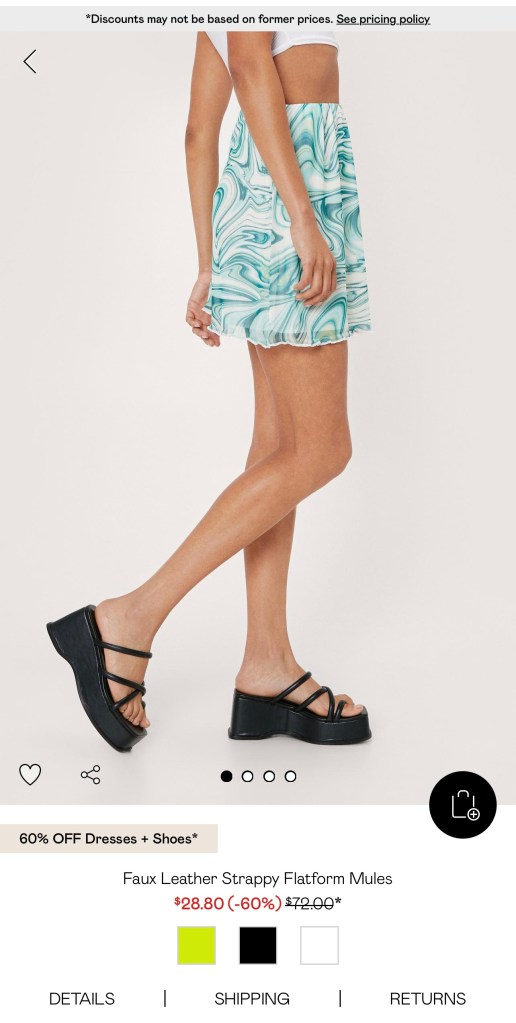
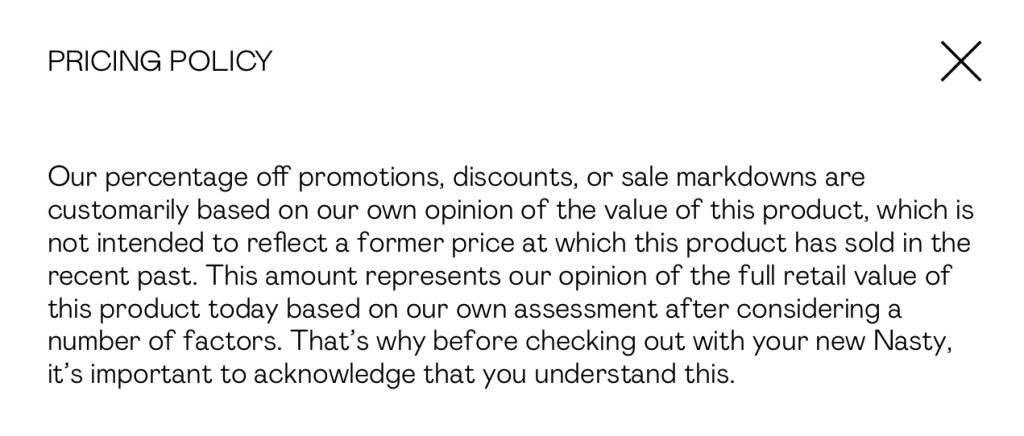
I click over to the app to see what they have going on. And I notice a little asterisk at the top of the product image when I tapped on something. The note beside it said “Discounts may not be based on former prices.” So I click to see the pricing policy. Because if not former prices, what would the discounts be based on?
“Our percentage off promotions, discounts, or sale markdowns are customarily based on our own opinion of the value of this product, which is not intended to reflect a former price at which this product has sold in the recent past. This amount represents our opinion of the full retail value of this product today based on our own assessment after considering a number of factors. That’s why before checking out with your new Nasty, it’s important to acknowledge that you understand this.”
Discount prices based on their opinions… not prior prices.
First of all, whoever wrote that disclaimer needs to be jailed for making people read that last sentence alone, period. “Before checking out with your new nasty” UGH! I get that the business is called Nasty Gal, but don’t you ever do that again, do not ever refer to your products as Nasty, like the noun. Heinous.
Nasty Gal always has at least a 50% off sale. So they have these inflated prices striked through with these incredible 50% off “deal” prices, which is a tactic to encourage people to buy it now, before the price goes up. It’s also one of those sites with no reviews. And their return policy? You get 28 days to return and you have to pay for the shipping!
I made a return with them for the first time, and when I found out that was their return policy? I don’t think I’ll ever buy from them again. I might look at the app for inspiration, but the quality isn’t all that when it comes to the clothes and shoes, and I’m trying to invest in jewelry that will actually last, so I have no business over there, and I would not recommend it to my dear readers unless you are in desperate need for some very trendy but very cheap accessories. And not even then, really.
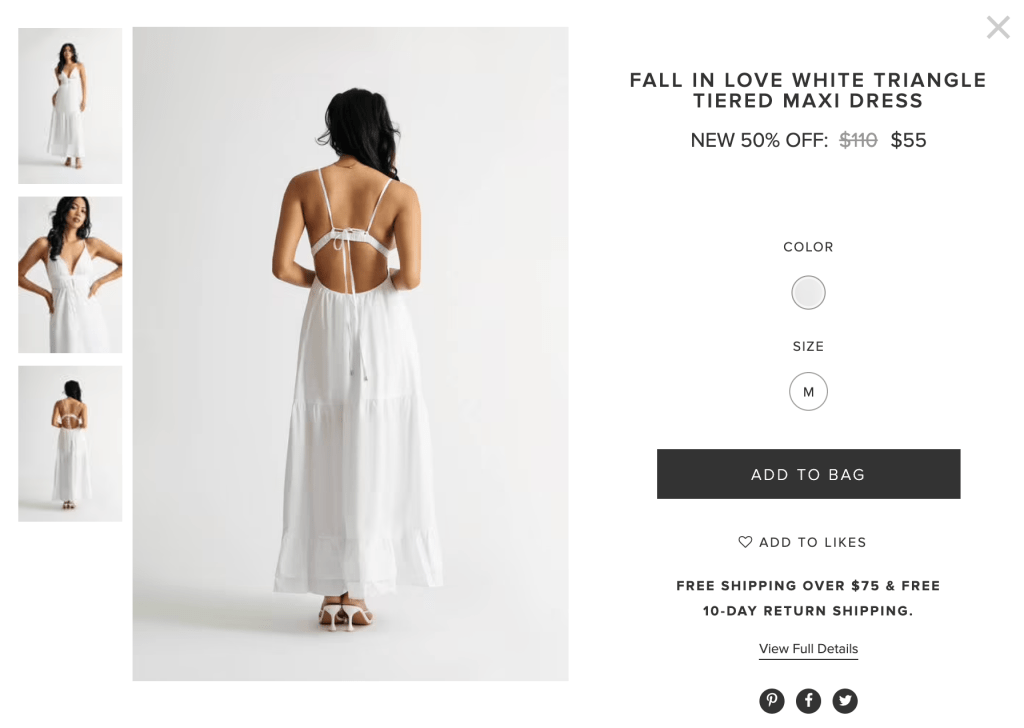
Tobi. I just wanted a third point (I ended up coming up with a 4th one, so honestly it doesn’t even really matter), so no real offense intended to Tobi, I generally love what I get from them (although their sizing is ridiculous, I think they only do XS-L, so they can work on that). But point three is the backless trend. And as far as places I buy from, Tobi is definitely one of the main offenders.
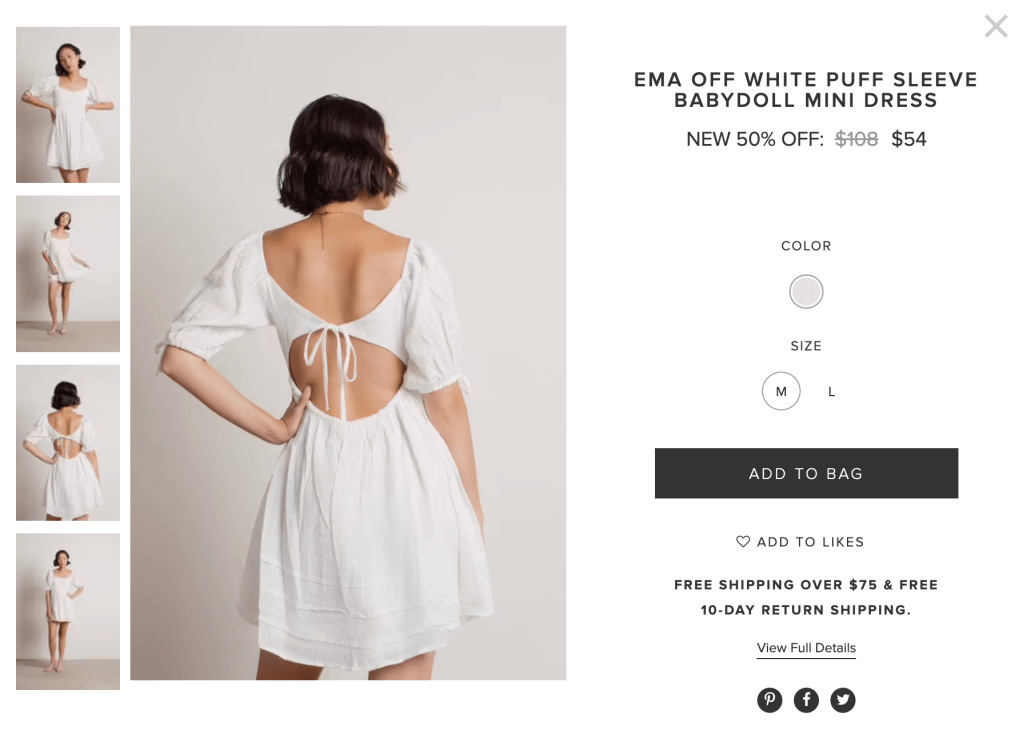
Every time I think I’ve found a dress or top that could work, boom, third photo in the carousel shows the entire back is out. It’s held together by a single thread and the last of the praying grandmothers. Bring back BACKS. Why does every dress have to be backless? GIVE ME THE BACK. Make it backFULL. Some of us wear BRAS. Yes, boob tape exists. And that has nothing to do with me.
I’ve noticed this in swimsuits too. Personally, I like my swimsuits to be a little more conservative, and I also like them to be simple. A one piece is perfect for me. But with all the cutouts some of these one pieces y’all are coming out with have, what’s the point? A cutout in the front, and a keyhole in the top, and a criss-cross cutout back? What are we doing here? And oftentimes the cutouts don’t even be in flattering places. Like, a giant cutout in the middle of your back? Why? Just a massive expanse of skin in the middle of you? What’s the purpose of that when we think about where we want the eye to go? Maybe I don’t know anything, but that doesn’t seem right. But yeah, I’ll die behind that. These cutout one pieces are ugly, and the ones that aren’t might as well be bikinis.
And don’t even get me started on the material being used for swimsuits. What, pray tell, is the logic behind a ribbed bathing suit? If I have a sweater in this material, I should not be seeing bathing suits cut from the same cloth!
My 4th and final point is an observation about the state of fashion in general: we are in an epidemic of ugly dresses. Like I mentioned, I was in a wedding recently and it was also graduation season, so I was in the market for a couple of new dresses. And oh my word. We are destroying our planet to mass produce the ugliest fast fashion imaginable, we really are not seeing heaven. It’s the fiery furnace for us. And with the way this planet is heating up, that’s BEFORE we even get to hell.
Pay close attention to what I say next. Too. Many. Design. Elements. Does it need to have ruffles, and ruching, and stripes, and a floral print, and cutouts, a deep V down to your sternum, and a lettuce hem? What are we *doing*? Is this who we *are*? Not only have we lost the plot, the last place we saw it was a labyrinth in Crete. I don’t know if we’ll ever find our way back.
Those were all my major complaints. I’m not even gonna touch Shein because I don’t know anything about it, but I’ve heard two main things, one of which is child labor. They’re not the only ones doing that. But the other is lead?? There’s lead in the clothes?? Why?? What exactly is the draw? Paying ONLY a dollar to get lead poisoning from a crop top? I’m not convinced!
We really need to stop purchasing fast fashion at the rate that we are. I’m obviously guilty, too. I’m not Jesus preaching to the Pharisees. I’m shoveling fuel into the firebox of this evil, out-of-control locomotive just like everyone else. But I just think it’s just *that* much more insulting when the clothes are UGLY and the brands wanna pull stunts. PICK ONE!!
In terms of things we can do, not buying clothes as often is a big one. I’m sorry to the influencer girlies. The haul culture needs to stop. The landfills are at capacity. Thrifting is probably the best we can do. Buying clothes that already exist. I have this shirt that I thrifted in college. My sister makes fun of me for how often I wear it, but shouldn’t that be the goal! To have clothes we love and rewear. And it’s so cool to think that shirt had a life before me and stands to have a life after me. Plus I probably paid $5-$10 for it, so the cost per wear is pennies. With that said, DO NOT clean the thrift stores out to resell. Don’t even get me started on the Depop resellers pricing clothes like they’re brand new. I don’t have a heaven or hell to put people in, but if I did? Resellers, you should be scared of where you’re going.
That concludes my thoughts on why the online stores, really just the fashion industry, need to be stopped. And I guess I am mainly talking about fast fashion. But quiet as it’s kept, the sustainable brands are making some ugly stuff too. I don’t like to say it, but the garments speak for themselves.
Thank you for reading this blog post. Like, comment, follow. Share with a friend who likes to laugh or is consuming at an unsustainable rate. It can really feel like there’s not much we can do to mitigate the impact of fast fashion as individual citizens who still need to clothe ourselves, but I will share some resources about fast fashion since I didn’t even touch on microplastics and the impact on the environment, the *shocking* and *sad* quality, and the despicable conditions and poverty wages that the people who make the clothes are forced to accept. I was in the process of signing off, but I had to drive that point home. Thanks again. Bye!
In July 2022, my family and I were in France for a wedding, and during the leg of the trip when we stayed in Paris, my mom and I went to a botanical garden called the Jardin des Plantes.
My mother has been doing flower arrangements since her late teens or early twenties and co-created the Flower Guild ministry for our church in 2002. Whenever I see a plant I don’t recognize or want to know more about, I can ask her. I’m still thinking of starting a podcast with my mom where we focus each episode on a certain plant and she answers my questions or tells any stories she might have about that plant. We’re perfectly situated to have a plant-themed podcast considering that her name is Fern.
Flowers are probably my favorite things to photograph, maybe because it’s difficult to take a bad picture of a flower (though I’ve definitely done it). I also love all of the variation you’ll see when you spend a lot of time looking at plants. It’s a reminder that there are so many different ways for something to be beautiful. So when I considered what my first photography post should be about, our trip to the Jardin des Plantes de Paris stood out in my mind.
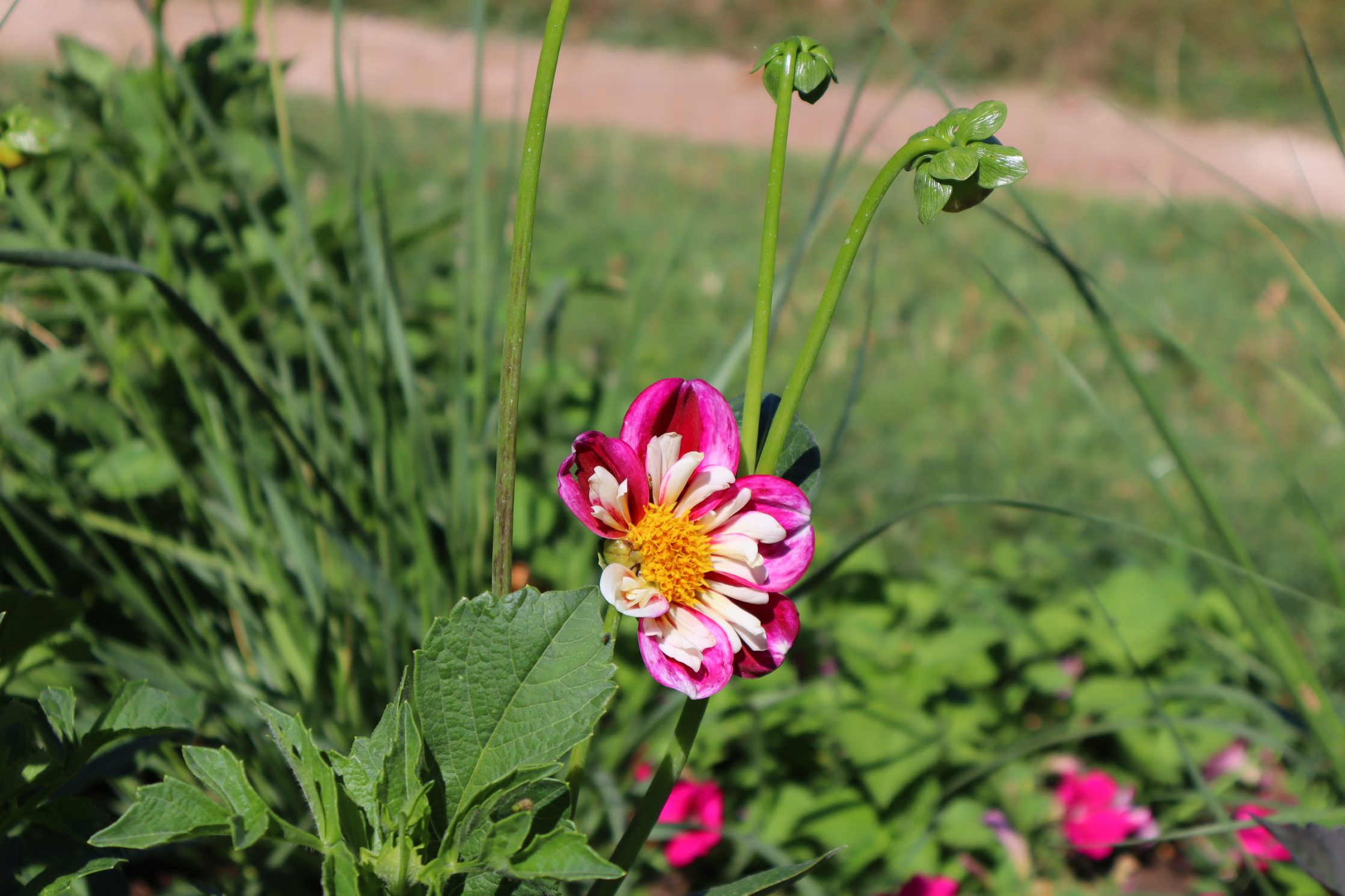
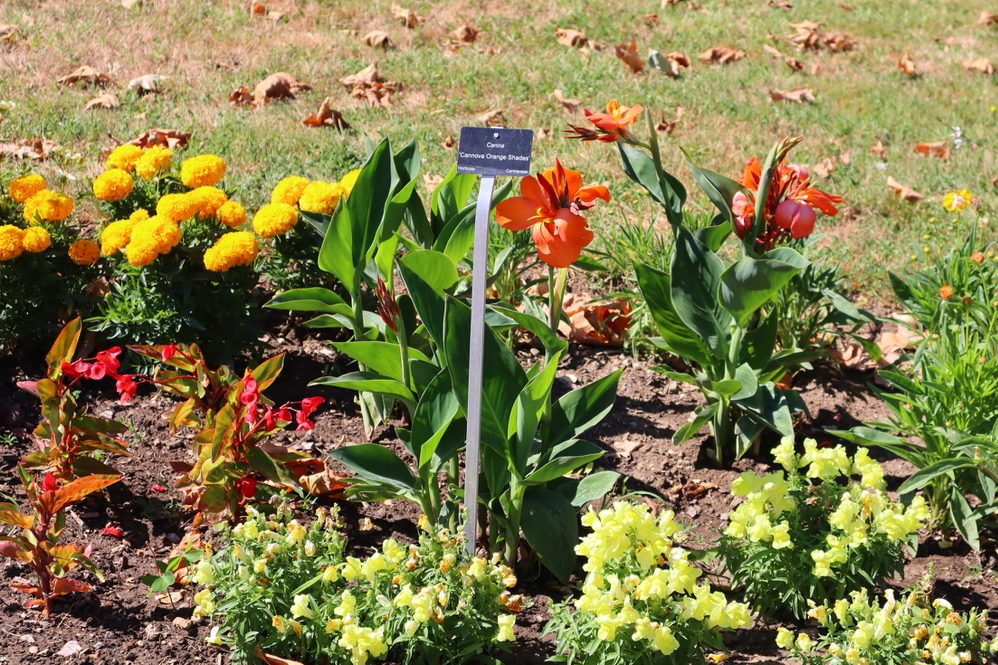
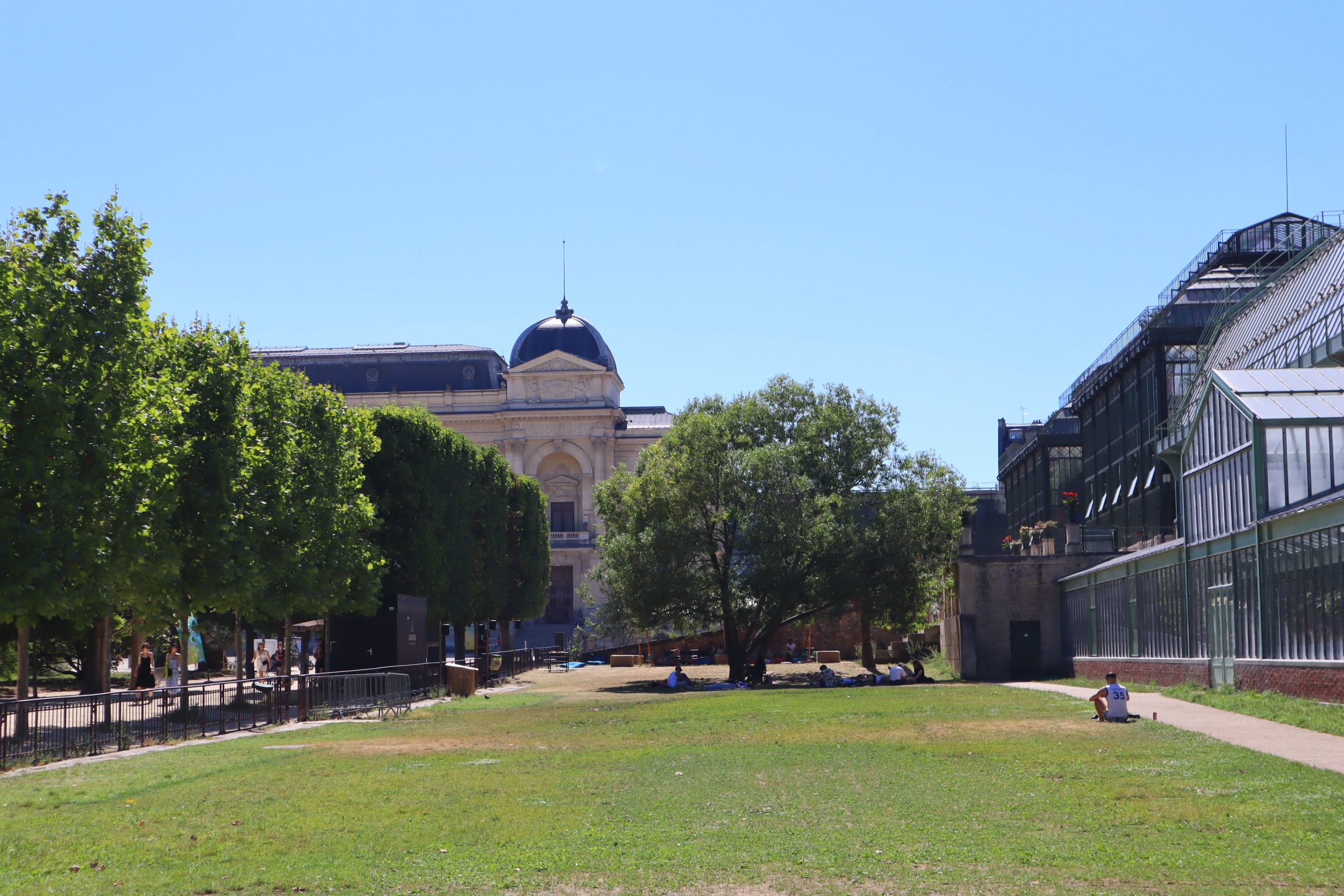
I was *transfixed* by the sunflowers at the Jardin des Plantes. This variation of the common sunflower is called the Ring of Fire cultivar for the ring of red around the center of the bloom. The way the sun hit the two-toned petals was so beautiful.This building is the Grande Galerie de l’Évolution, or the Gallery of Evolution, one of five buildings in the Jardin des Plantes de Paris that make up the National Museum of Natural History.I love the dimension dahlias have; their densely layered petals make them look so unique. I don’t think I had ever seen dahlias that looked like the red and white ones pictured here. There was a little bee who also seemed to be enjoying the dahlias 🙂
The crows had the run of the place.
They were so bold. The only ones security didn’t bother when they walked on the grass.
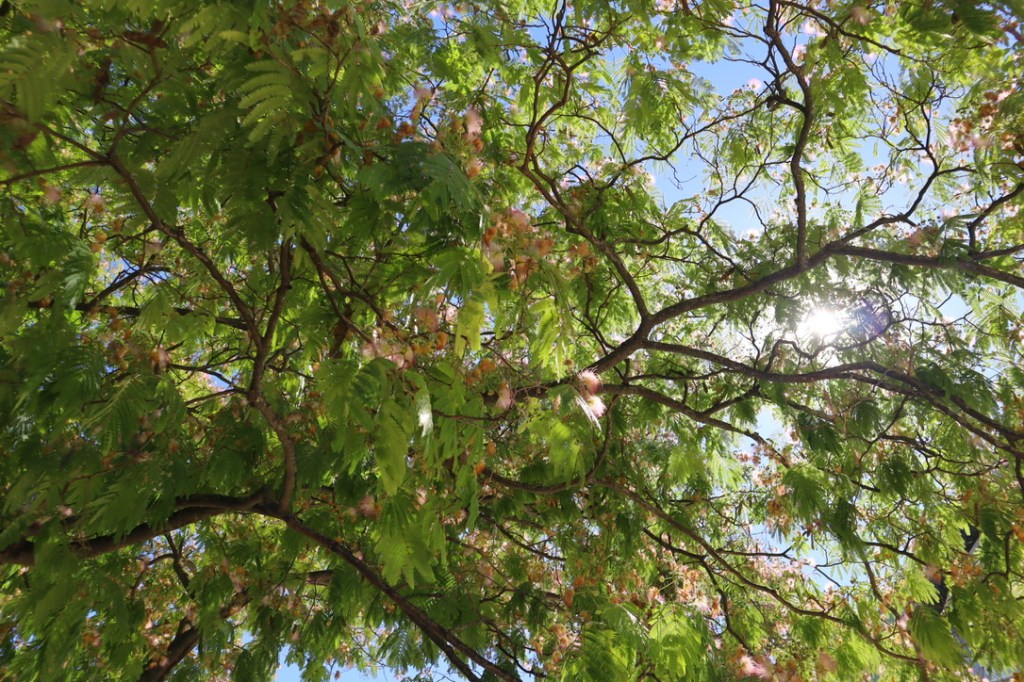
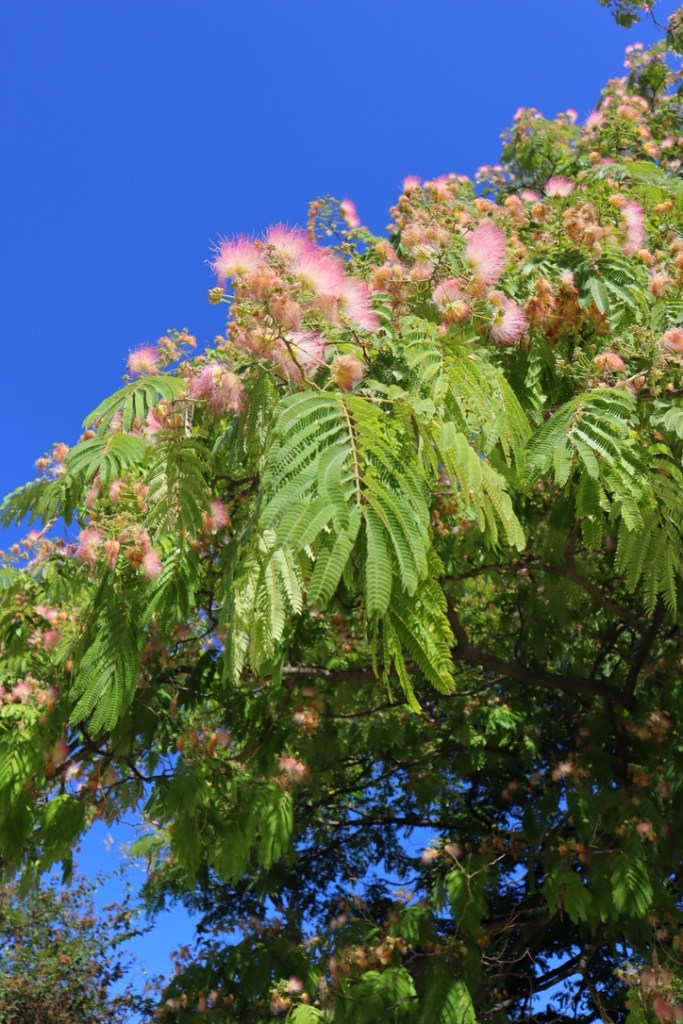
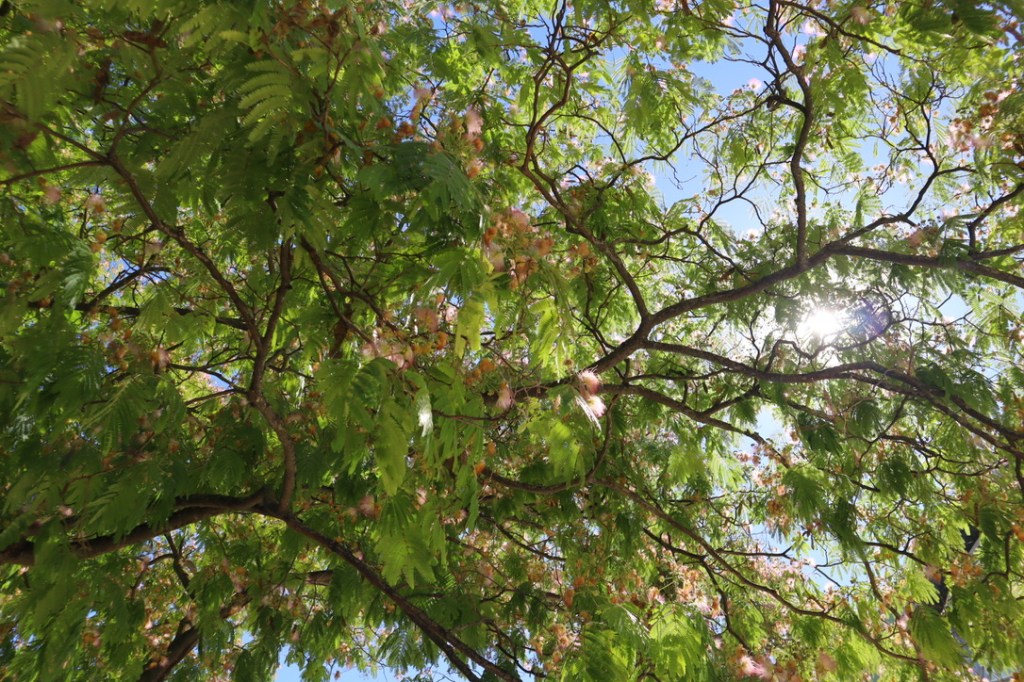
There were greenhouses, but we didn’t go inside — I think you had to pay for entry. Gives us something to look forward to for next time!This tree was just breathtaking. It looks like it’s from another planet — the leaves are like ferns, and the blooms are like feathers. I think it’s called a silk tree. I’m obsessed.
Thank you for reading! And for looking at some pictures I took while I had a nice day with my mom ♡
As ever, coddling men and sacrificing women at the pyre…
TW: mention of rape, suicide, gun violence
I was recently talking to my friend, shoutout Milena, about how I want to make content in some capacity about alpha males, the manosphere, incels, but I just don’t know what the most ethical and safe way to do that is. And I would have to have a friend or family member look at the mess with me because I *would* spiral scripting that on my own. She informed me about some discourse that I would see on my own timeline not much later, and the discourse is about “the right to sex.”
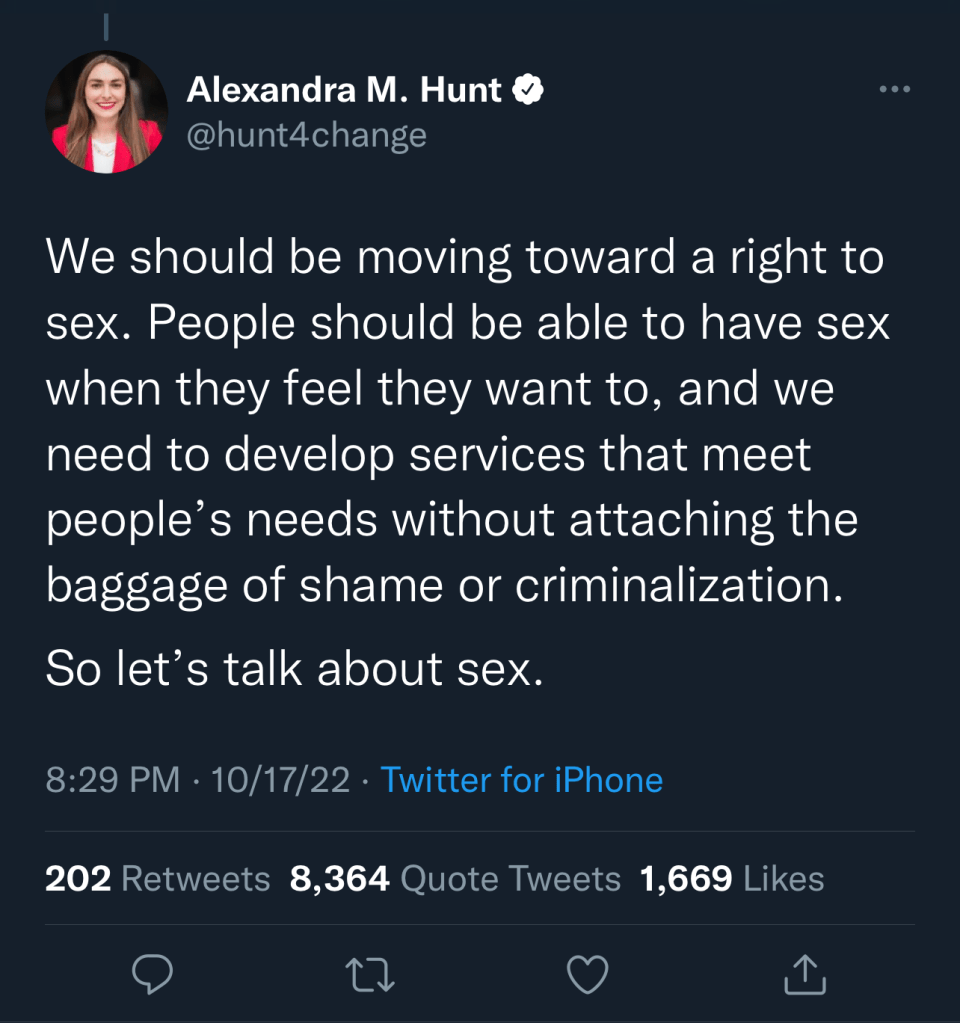
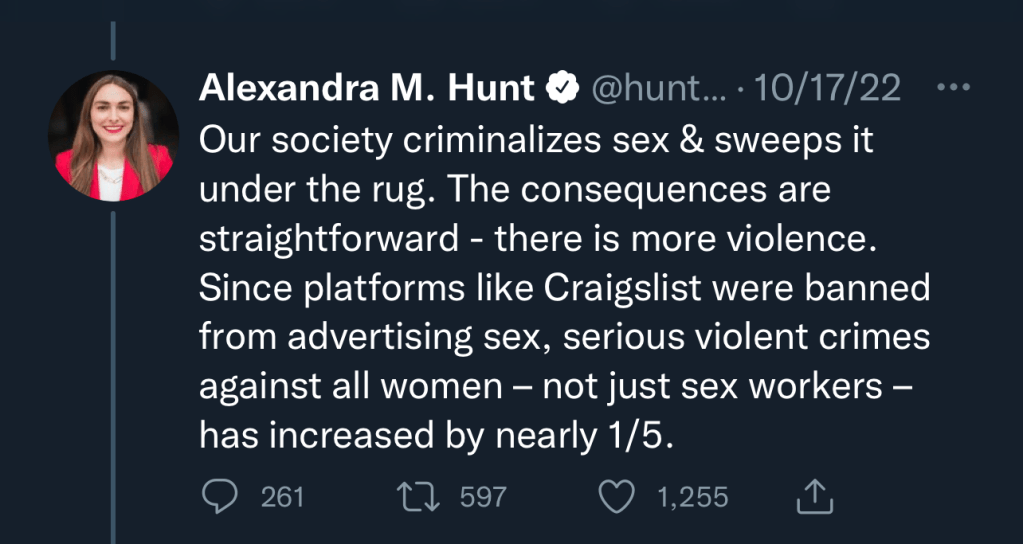
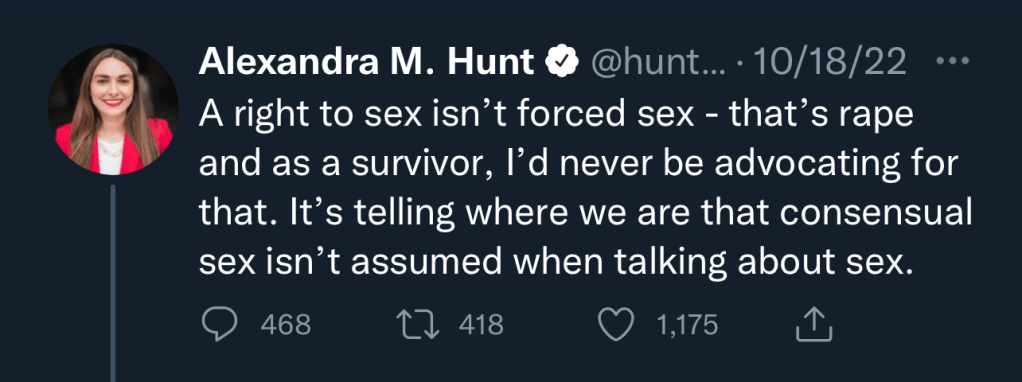
The first tweet I saw was this one, and honestly? I would have agreed if it weren’t for the first sentence and a half because, aside from the language about what we have a right to, it just sounds like she’s arguing for decriminalization. But that is not the only argument being made here. Not even close.
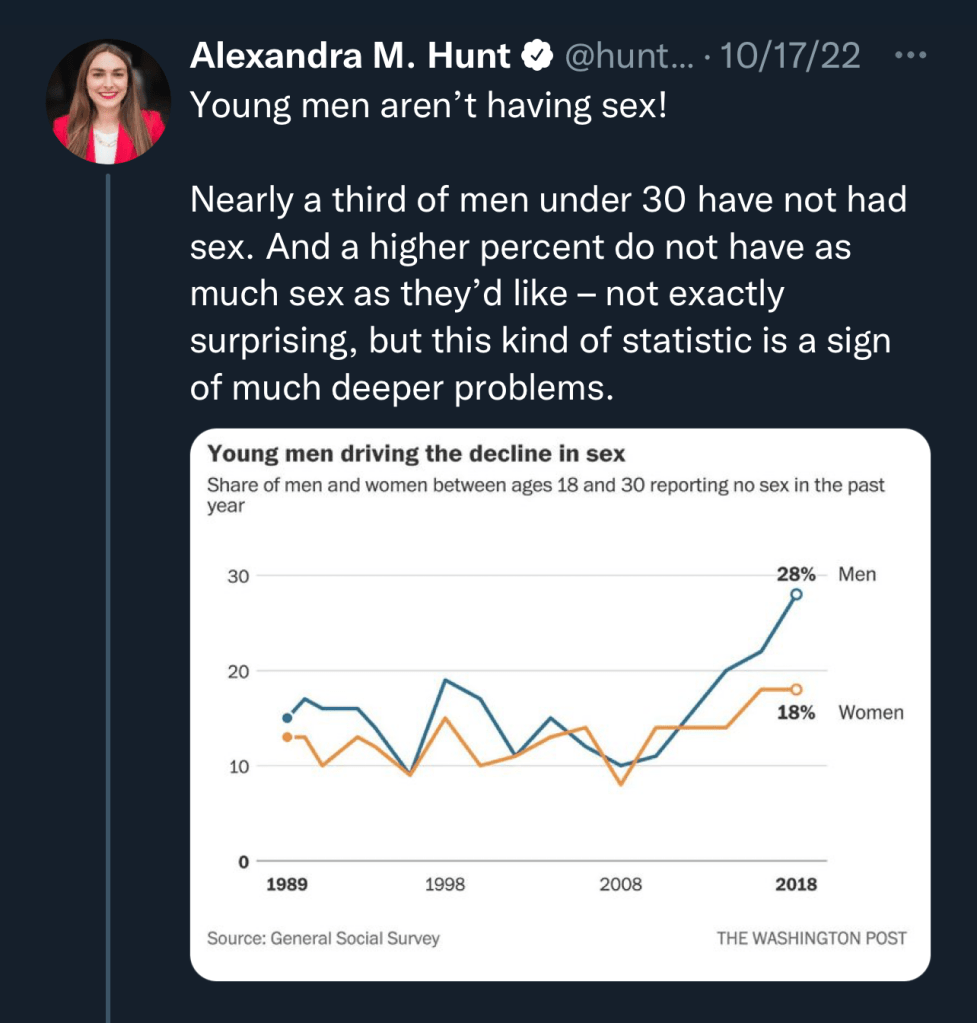
If you scroll further up in the thread, it begins with the words, “Young men aren’t having sex.”
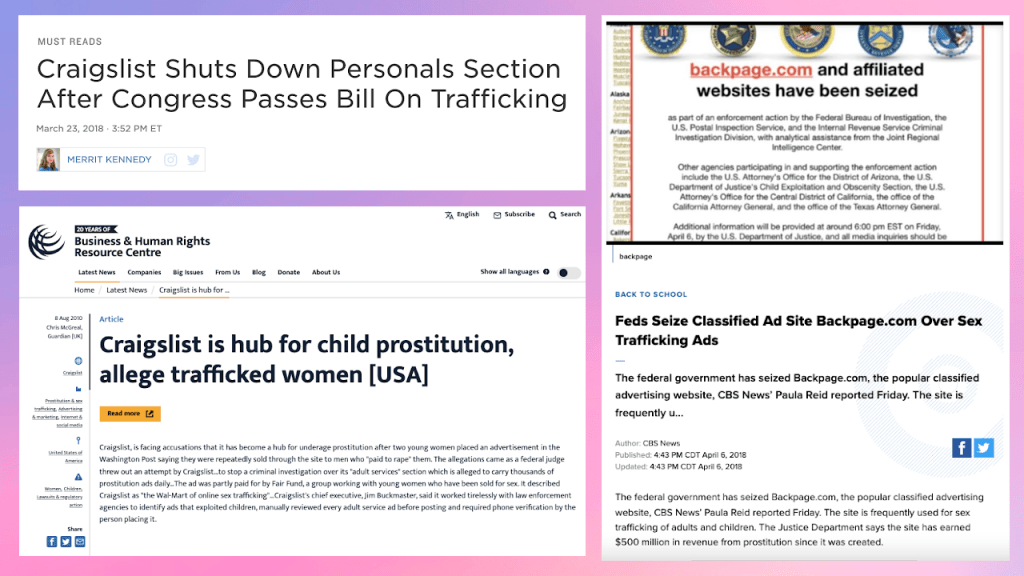
I *need* to rebut this point and then I promise I’m going to show the rest of the thread. It seems like a reach to me to link advertisements for sex on specific platforms with an uptick in violent crime against women. I don’t look at that statement and see causation, and a number of people have responded to this tweet in particular by pointing out that Craigslist and sites like it where sex could be advertised were a lot more reliably linked to trafficking. But even working under the assumption that the end of ads for sex on these websites is connected to violent crimes committed by men against women, the people you’re blaming in this scenario are women for not providing men whatever right amount of sex will keep them from going on violent rampages.
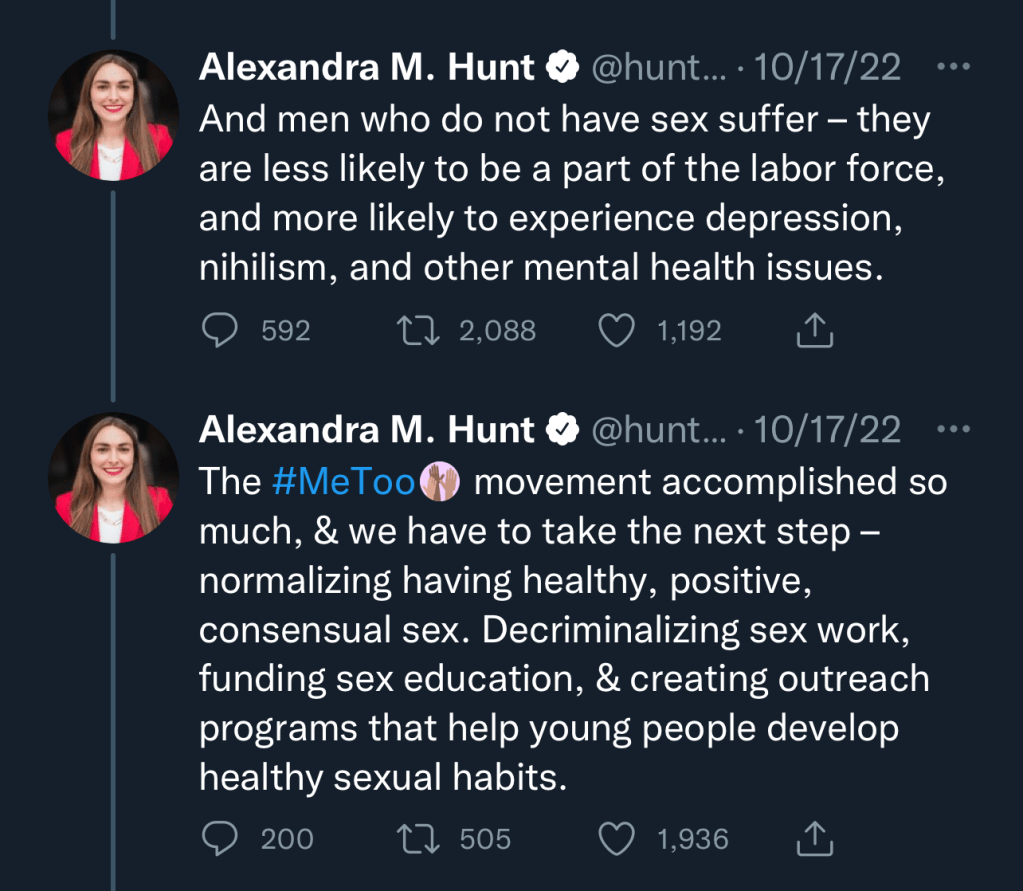
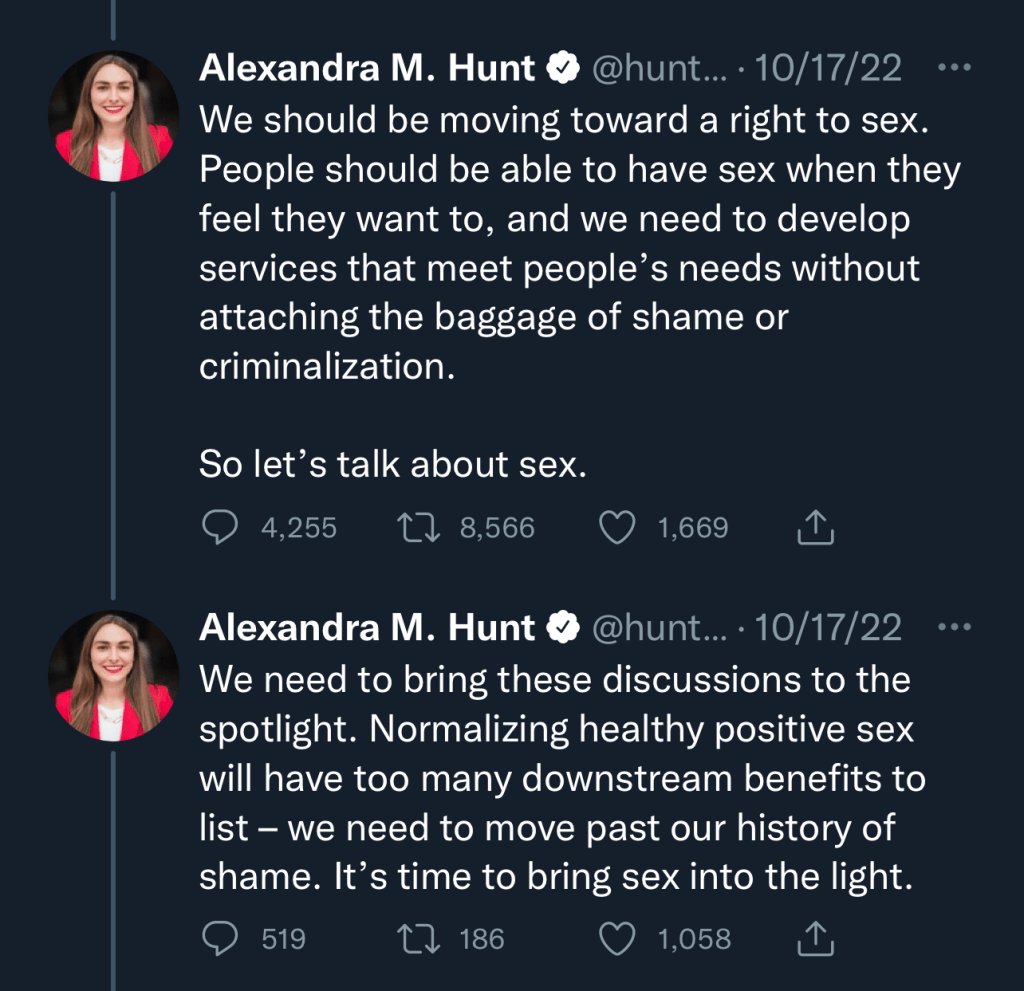
Let’s finish the thread.
So I agree that we are in desperate need of better sex education, I agree that there should be less stigma around doing and accessing sex work. I’ll even concede that men who aren’t having a ton of sex might, in fact, suffer in the ways she’s described. But that’s not because men aren’t physically having sex. It’s because of patriarchal standards for what men’s sexual desire and behavior should look like.
And you don’t have a right to sex! You don’t get to have sex whenever you want! If you have a 9-5, and at 2pm, you get the urge: you wanna have sex. You can’t!! Because you have a job! You signed a contract. If you watch Grey’s Anatomy, this point probably doesn’t hold all the way up, but you get what I’m trying to say. And I know I’m being literal, I’m being facetious, but I just don’t get it. “People should be able to have sex when they feel they want to.” But that isn’t how things work. We don’t even get to have health care whenever we want. Or food, clean water, shelter. And you don’t need sex to keep staying alive. So I can’t conceive of how someone thought this should be on our list of priorities as a society. *Especially* within 4 months of Roe v. Wade being overturned.
The author of this thread is Alexandra M. Hunt. She is a public health activist, grassroots organizer, and 2022 Philadelphia Congressional candidate. And as you can imagine, Hunt has come under a lot of scrutiny for her original thread. She has since done some explaining and issued a statement that I will share towards the end of the essay.
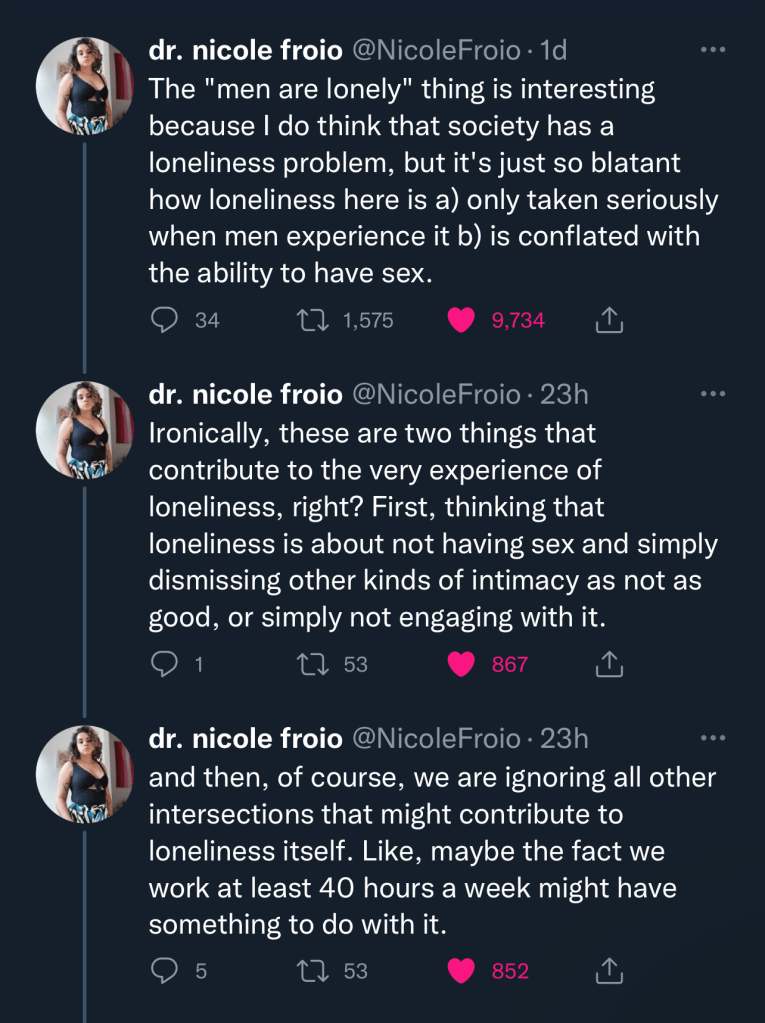
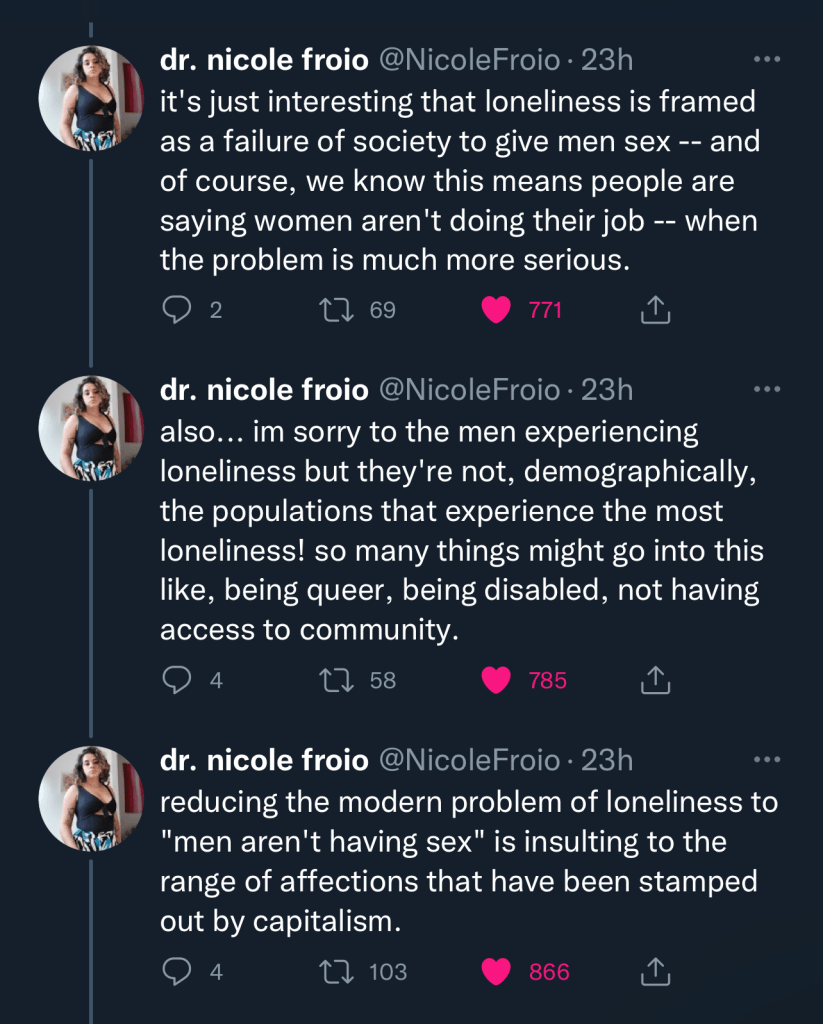
But before I share Hunt’s final thoughts, I want to read some responses to her multiple posts on this subject, and the first is from Dr. Nicole Froio, a Doctor in Women’s Studies, writer, researcher, and reporter.
Dr. Froio is exactly right. Loneliness is a huge problem for our society as a whole. Scott Galloway’s book Adrift includes a visual for the decline in friendship in the United States, using data from a 1990 Gallup survey as well as the May 2021 American Perspectives Survey. This visual shows that Americans reported having fewer close friends in 2021 than in 1990. In 2021, 15% of men and 10% of women reported having no close friends. But I don’t see politicians discussing how we can address that. We don’t take this lack of friendship as seriously as lack of sex. We treat sex like it’s this mystical thing at the core of the human experience and at the top of the hierarchy of how we relate to one another, and that dooms us all to be very lonely and probably very disappointed.
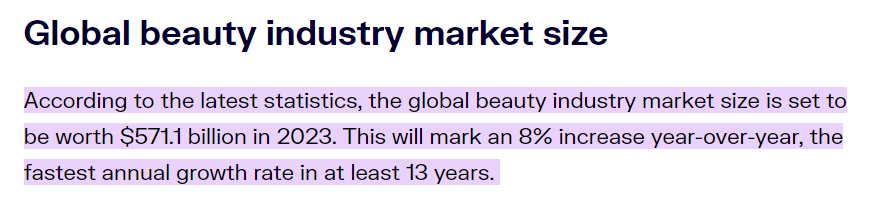
It’s also very infuriating to think about the many ways capitalism, which has gotten us to this lonely place, also tries to sell itself to us as the solution. And this applies to everyone living under capitalism, but especially women. Women are constantly sold the narrative that our loneliness is a personal failing and the answer is to conform to arbitrary standards in some way, usually involving paying for a product or service. The global beauty industry is worth half a trillion dollars. And I think that has something to do with the fact that women who feel alone or unloved or unfulfilled are encouraged at every turn to invest in beauty and desirability. The increased focus on self-care in recent years also fits into this as it’s primarily aimed at women and tells them that the way to address all the unpleasantness of life is to buy a 12-pack of sheet masks and a jade roller and enjoy a bubble bath with the precious hours before they have to go back to work or school or their responsibilities as a parent or caregiver. No acknowledgement of any systemic reasons women might feel so exhausted and isolated. Just skincare and girlboss rhetoric.
And this, of course, isn’t to say that men’s issues related to loneliness and isolation are handled appropriately. In the United States, men are about 4 times more likely to die by suicide than women, but I only really see this talked about when there’s been another mass shooting or as a “gotcha” when women’s issues are being discussed. So if someone is talking about high rates of mental illness in women or the career and relational challenges faced by new mothers or just the fact that men have privileges that women don’t, that’s when men’s struggles with mental health or societal pressures or lack of meaningful relationships are brought up. Not in good faith, not in a constructive way, not with people who have the immediate ability to address those issues. But as a means to derail conversations about or organizing for the improvement of women’s situations. Women deserve better. And I think men deserve better than that, too.
The political nature of loneliness is something I want to talk about more in depth in the future, and I found this great article by Eleanor Wilkinson called Loneliness is a feminist issue, which I want to quote from briefly before moving on.
“Perhaps, then, at times the language of loneliness is used when we should in fact be talking about structural abandonment, precarity and alienation under late capitalism. The language of loneliness individualises these feelings of lack and longing: the problem is framed as personal rather than structural. The language of loneliness also flattens, precluding any discussion of structural inequalities: loneliness becomes seen as an individual disorder to which anyone might succumb. This framing of loneliness becomes a way to circumvent issues of state abandonment: it downplays the ways in which certain bodies are cast out, forced to endure conditions that so often condemn them to isolated lives, that make connections fragile, that grind us down. The language of the ‘loneliness crisis’ masks a series of other crises: rising economic precarity, the dismantling of the welfare state, displacement, systemic racism, the continued dominance of heteropatriarchy. My proposition, then, is that rather than seeing loneliness as a biomedical disorder or a personal failure, we can think of loneliness as a structural condition, arising from particular ‘violent conditions’ (Laurie and Shaw, 2018).”
Loneliness more broadly is a problem created by current structures, but it isn’t spoken about that way, and there aren’t a lot of politicians who name it as something to be addressed through policy. Feelings of loneliness also aren’t taken as seriously if you aren’t a man.
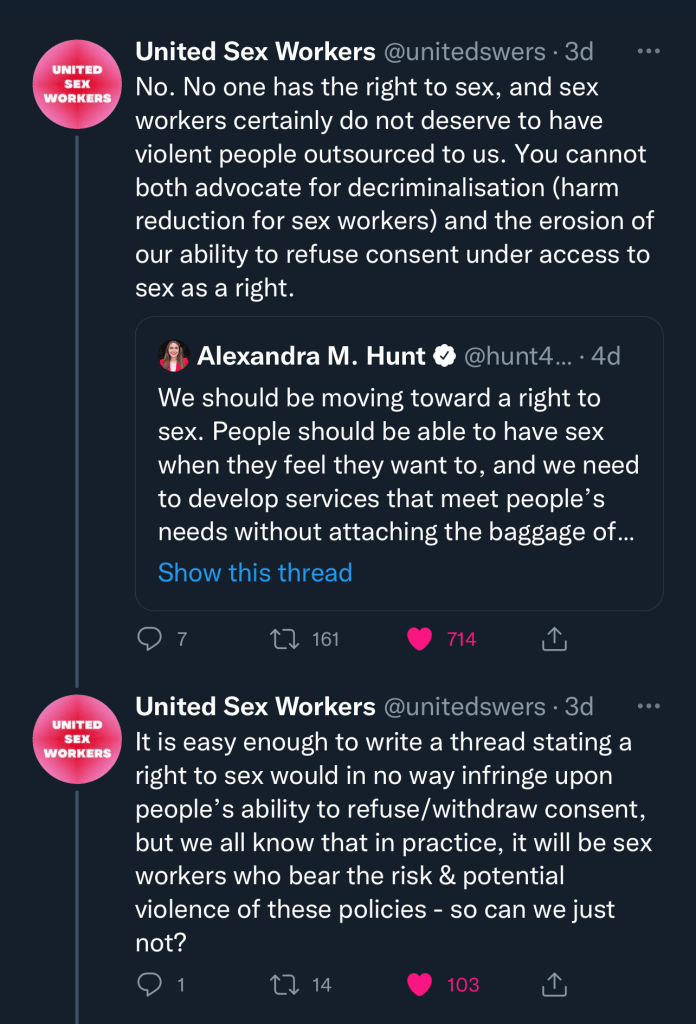
United Sex Workers is a branch of strippers and sex workers in the UK organizing for better conditions for those working in the sex industry, and they also had a response to what Alexandra Hunt posted.
This brings up the question of what a “right to sex” would look like. Because Hunt named things like decriminalization of sex work, more funding towards sex education, and outreach programs for young people. But the “right to sex” framing set off alarm bells. Because words mean things. When you have a right to something and someone else violates that right, you have legal recourse. There are steps you can take to see that violation redressed, including suing for damages. Opening sex workers up to potential lawsuits – or even just the inflated sense of entitlement that a codified right to sex could nurture in clients – puts this already marginalized demographic at even greater risk.
USW’s response is very important because there is so much nuance that Hunt did not account for, which makes her initial statements lacking at best, dangerous at worst.
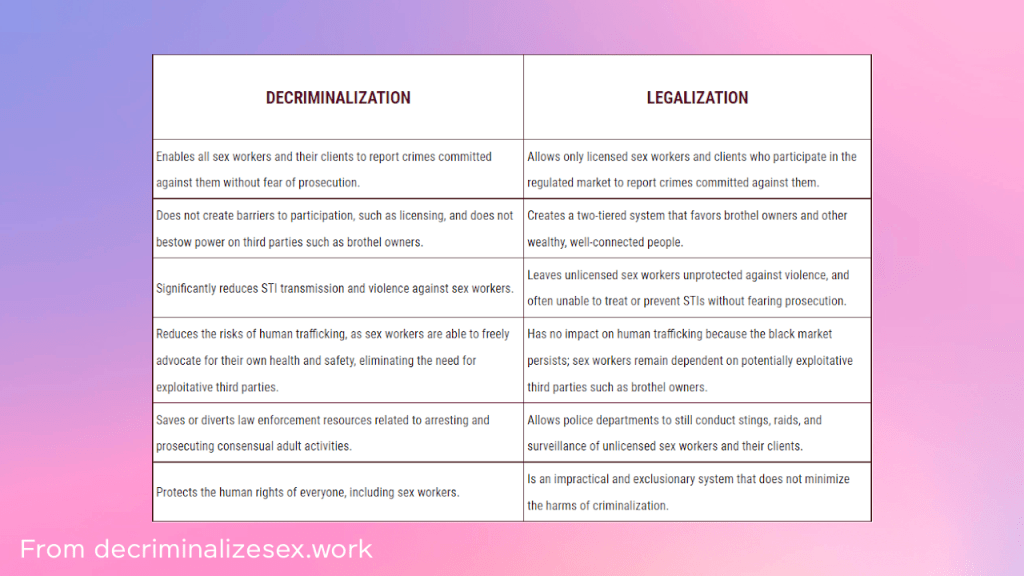
If you’re not familiar with the difference between decriminalizing and legalizing sex work, I have a breakdown from Decriminalize Sex Work (DSW), a 501(c)(3) national nonprofit founded in 2018 which works to improve public attitudes towards sex work and its decriminalization through public education, policy research, and outreach.
“Legalizing sex work would create a set of laws, codes, and regulations specific to the sex industry. People who buy or sell sex outside of these rules would be breaking the law and subject to arrest.”
“Decriminalizing sex work means that consenting adults who buy or sell sex are not committing a crime. There would, of course, still be laws against trafficking, rape, violence, and sex work involving minors.”
While that may sound simple enough, we are not in the place to be talking about decriminalization of sex work based on how much easier it would make it for men to have sex. Criminalization vs. decriminalization vs. legalization are very complicated, which is another facet of this discourse that Milena brought to my attention. When we were in college, she wrote a paper about the complexities of legalizing sex work, and she was gracious enough to share a couple of sources she used, so big ups to my co-researcher for this video for real. One of the sources she shared with me, a 2014 article from the Harvard Law & International Development Society, cites a 2012 study called “Does Legalized Prostitution Increase Human Trafficking?” and shares the following findings:
“Countries with legalized prostitution are associated with higher human trafficking inflows than countries where prostitution is prohibited. The scale effect of legalizing prostitution, i.e. expansion of the market, outweighs the substitution effect, where legal sex workers are favored over illegal workers. On average, countries with legalized prostitution report a greater incidence of human trafficking inflows.”
“Criminalization of prostitution in Sweden resulted in the shrinking of the prostitution market and the decline of human trafficking inflows. Cross-country comparisons of Sweden with Denmark (where prostitution is decriminalized) and Germany (expanded legalization of prostitution) are consistent with the quantitative analysis, showing that trafficking inflows decreased with criminalization and increased with legalization.”
“The type of legalization of prostitution does not matter — it only matters whether prostitution is legal or not. Whether third-party involvement (persons who facilitate the prostitution businesses, i.e, “pimps”) is allowed or not does not have an effect on human trafficking inflows into a country. Legalization of prostitution itself is more important in explaining human trafficking than the type of legalization.”
The researchers note that legalization can improve working conditions for sex workers substantially and that when prostitution is criminalized, sex workers are the ones who are penalized as opposed to the traffickers, so they aren’t arguing for prohibition; they’re calling for further investigation into the relationship between legalization and trafficking. But the idea that legalization might actually worsen trafficking is still so difficult to sit with.
A 2021 article I found from the Global Policy Journal called “Legalizing Prostitution: Does it Increase or Decrease Sex Trafficking?” examines large, multi-national correlational studies and in-depth case studies to come to a conclusion about legalization. The author ultimately reasons that case studies as opposed to those large-scale studies of multiple countries are a better indicator of how different policy implementations actually affect sex workers. One of the case studies he summarizes, which I’ll go over here, focuses on Australia.
“Another major study compared different regimes in three Australian cities: criminalization in Perth (Western Australia), decriminalization in Sydney (New South Wales), and legalization in Melbourne (Victoria). On all of the health and safety measures, legalization ranked superior to criminalization. It also performed better than decriminalization, because legalization implies some kind of state regulation whereas decriminalization is a non-interventionist, laissez-faire approach. Melbourne’s legalized brothels were associated with more security measures and health protections than in the other two cities, and a greater proportion of its brothels were awarded a 5-star rating by data collectors who visited each site.”
This paints a different picture, one in which legalization comes out on top. However, I want to note that sex workers themselves overwhelmingly advocate for decriminalization as the solution. On the same page of the Decriminalize Sex Work website that I read from earlier is this table that breaks down the reasoning for decriminalization over legalization, and to summarize the arguments in the table, legalization creates barriers and hoops to jump through that might make doing sex work harder for workers and fails to protect unlicensed sex workers. In the interest of ensuring that standards are met, legalization is also likely to result in more surveillance and police involvement, which I would argue might make sex workers less safe.
This is a very important and very nuanced issue, and I think it should be treated as such. With the knowledge that we have so many variables to consider in order to maximize the wellbeing of sex workers, Hunt’s inclusion of decriminalizing sex work in her thread with respect to how much sex young men are having felt too cavalier. We cannot afford to be producing these arguments that treat sex workers as if they’re meant to absorb all of the worst gender-based violence. Because that is already the status quo. If we’re gonna talk about decrim, let’s do it because of the benefits to the workers, and let’s do it in a way that makes those workers feel dignified and not thrown under the bus.
We’ve considered Hunt’s proposal from a feminist (and anti-capitalist) perspective and taken a look at how sex workers might be affected. Now, I want to examine the “right to sex” discussion through an asexual lens. Because the existence of asexuality renders the starting point of Hunt’s argument completely insignificant. “Young men aren’t having sex!” Some men are asexual. Some men are celibate for other reasons. Some men don’t think about sex that much. The graphic Hunt includes in her first tweet in the thread shows that 28% of men aged 18-30 reported not having had sex in the past year. I couldn’t find the statistic about how many young men are having less sex than they’d like, so I guess I’m taking her word for that, but what if all those young men not having sex just didn’t want to? Then what? Because of the way masculinity and manhood are constructed in our society, men who refuse sex are stigmatized. And when we survey young men about their sexual activity and look at the results and say, “That’s a problem,” we are just doing the same thing we’ve always done, continuing that cycle of stigma and harmful teachings about what it means to be a man. And we’re putting young people in a very vulnerable position. One where they think they can’t say no.
This situation is a perfect example of compulsory sexuality. For an explanation of that concept, I have an excerpt from Ace by Angela Chen, which I recommend to everyone, but especially to those who don’t know anything about asexuality. Ace is an extremely valuable introductory resource.
“If the phrase compulsory sexuality sounds familiar, that’s because it borrows from poet Adrienne Rich’s concept of compulsory heterosexuality. In her 1980 essay ‘Compulsory Heterosexuality and Lesbian Existence,’ Rich argued that heterosexuality is not merely a sexual orientation that happens to be the orientation of most people. Heterosexuality is a political institution that is taught and conditioned and reinforced…Compulsory sexuality, an idea central to ace discourse, is not the belief that most people want sex and have sex and that sex can be pleasurable. Compulsory sexuality is a set of assumptions and behaviors that support the idea that every normal person is sexual, that not wanting (socially approved) sex is unnatural and wrong, and that people who don’t care about sexuality are missing out on an utterly necessary experience.”
That passage is from Chapter 3, Compulsory Sexuality and (Male) Asexual Existence. Chapter 4, Just Let Me Liberate You, is also immensely relevant to this conversation as it talks about the limitations of sex positivity, that when women express ambivalence towards sex it is always read as repression, and that
“Conspicuous consumption of sex has become a way to perform feminist politics.”
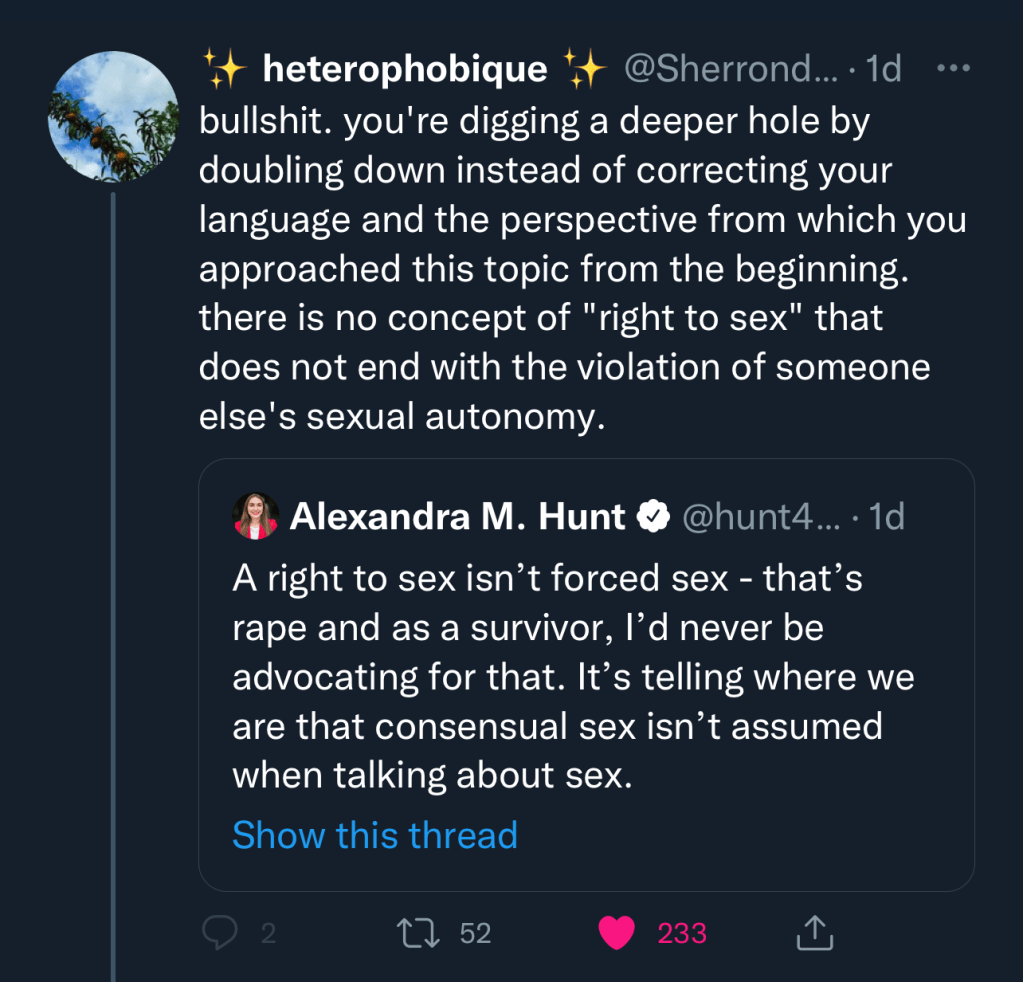
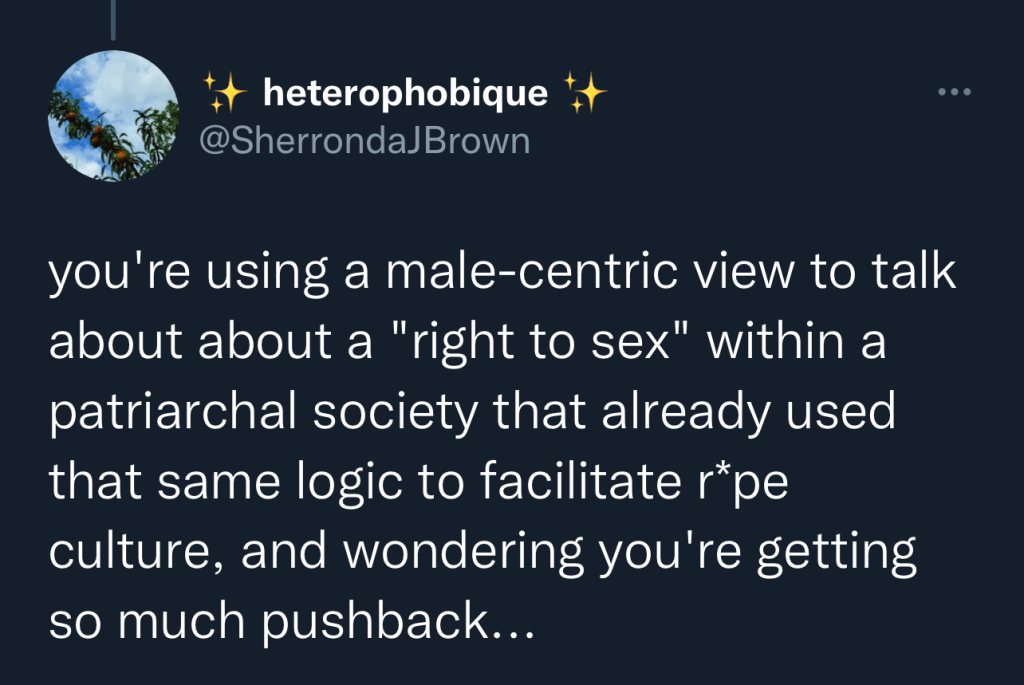
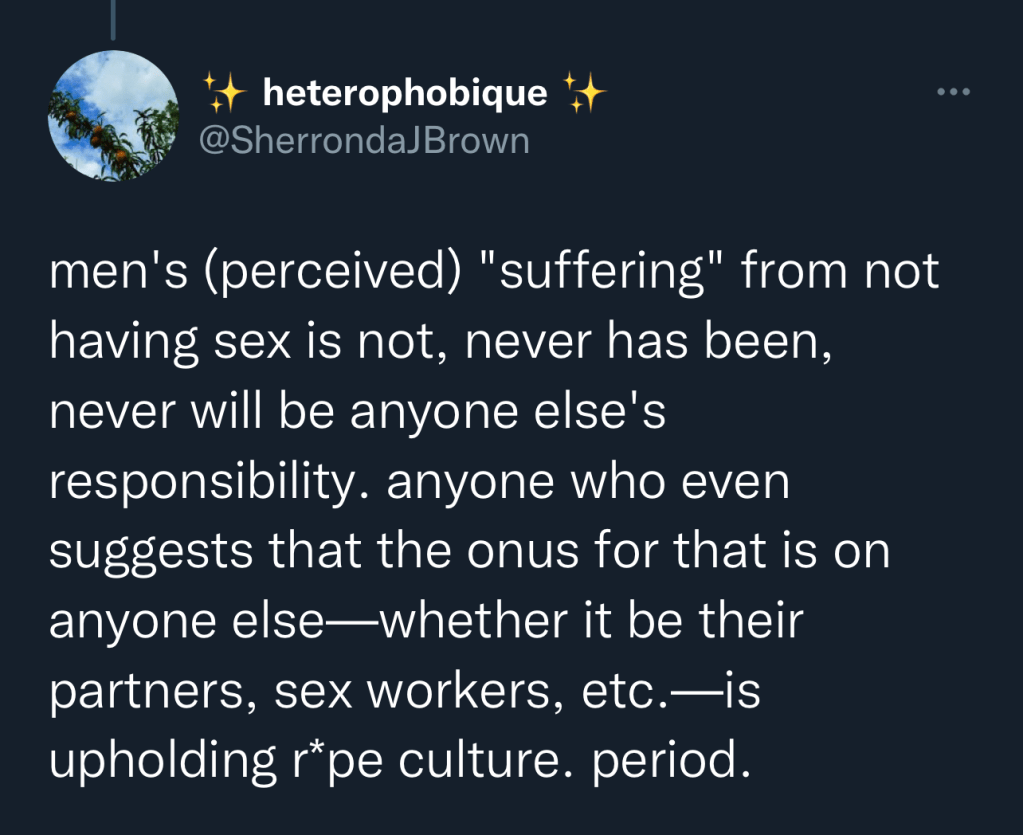
Sherronda J. Brown, who is a Black asexual essayist, editor, and storyteller (and the author of my most anticipated book of the year), also responded to Alexandra Hunt’s thread.
In the first tweet, Brown is replying to a follow-up that Hunt posted, which says,
I don’t like the “it’s telling where we are as a society that you all misinterpreted me this way” logic, not because it’s untrue, but I just think it says more about how you failed in presenting your argument if so many people had such fundamental critiques. I do agree we’re not in a place as a society to entertain this because we *do* to some extent still live under the idea that certain people have a right to sex. And if we know where that gets us, violent and often sexual crimes disproportionately against women, why would we not consider the worst case in evaluating what you’ve said? Also, if so many people responded so negatively to this argument, maybe hang it up.
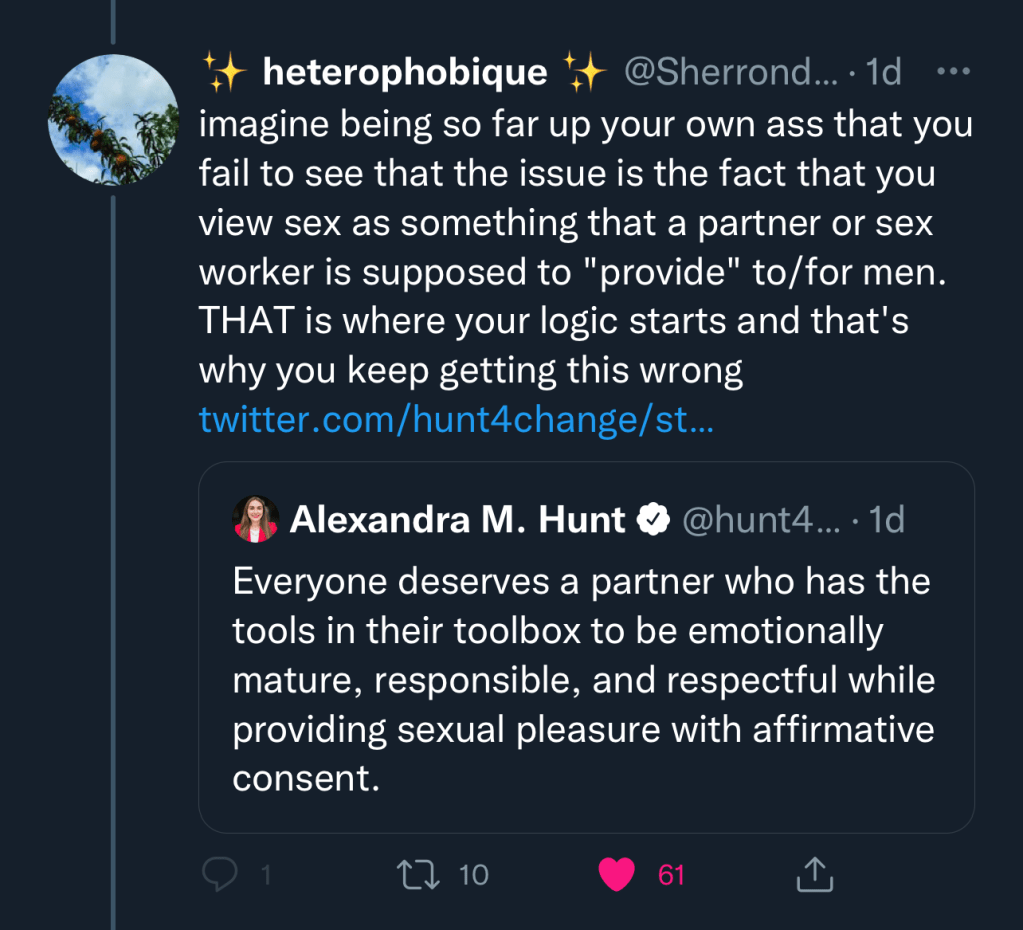
Sherronda J. Brown says,
Unfortunately, in her initial thread… yeah. Alexandra Hunt was repackaging rape culture and presenting it as progressivism. And this exact weird sex-as-a-right, savior thing Hunt is doing – and how it interacts with asexuality – is discussed in Refusing Compulsory Sexuality: A Black Asexual Lens on Our Sex-Obsessed Culture.
In the paragraph before, Sherronda J. Brown refers to misogynoir, patriarchy, white supremacy, and compulsory sexuality, labeling them oppressive ideas informed by other interlocking notions of power. Brown writes,
“The nexus where each of these meet is the ideology that sex is not only obligatory, but that it is a property and a ‘right’ owed, especially for those in power to use as they please. This is the same ideology that forms the bedrock for acephobia. It’s also what allows many allosexuals not only to believe that asexuals need to be ‘fixed’ or ‘realigned’ to conform with dominant social expectations, but also to appoint and empower themselves as the duty-bound authorities who must enact this repair and realignment — a delusion driven by their own entitlement and ego. It’s a dangerous and perverse savior complex that results in sexual violence against asexual people, and this fact highlights how much acephobia is deeply rooted in rape culture.”
I would definitely encourage you all to find a way to read Refusing Compulsory Sexuality. Sherronda J. Brown also wrote about this situation, about Hunt’s statements, in an article called ”There’s no such thing as a ‘right to sex,’” which I have linked here.
I have seen the counterargument (meaning defense of Hunt’s original argument) that this proposal calls not for any specific person to service you sexually but for the government to put forth the funds for you to pay a sex worker. I know there are subsidy schemes in the Netherlands, for example, that make this provision for disabled citizens. And people feel a multitude of ways about that. I think this is a better frame for this conversation and cements that what Hunt should’ve focused on was right to sexuality or sexual liberation, and that can be achieved for some with the help of professionals, whether those are sex therapists, sexologists, and/or sex workers. But ultimately, while I would like to see ideas like this discussed and developed in the U.S., I don’t want that to happen solely based on young men having less sex and being more violent. I think that’s a shaky foundation to build on.
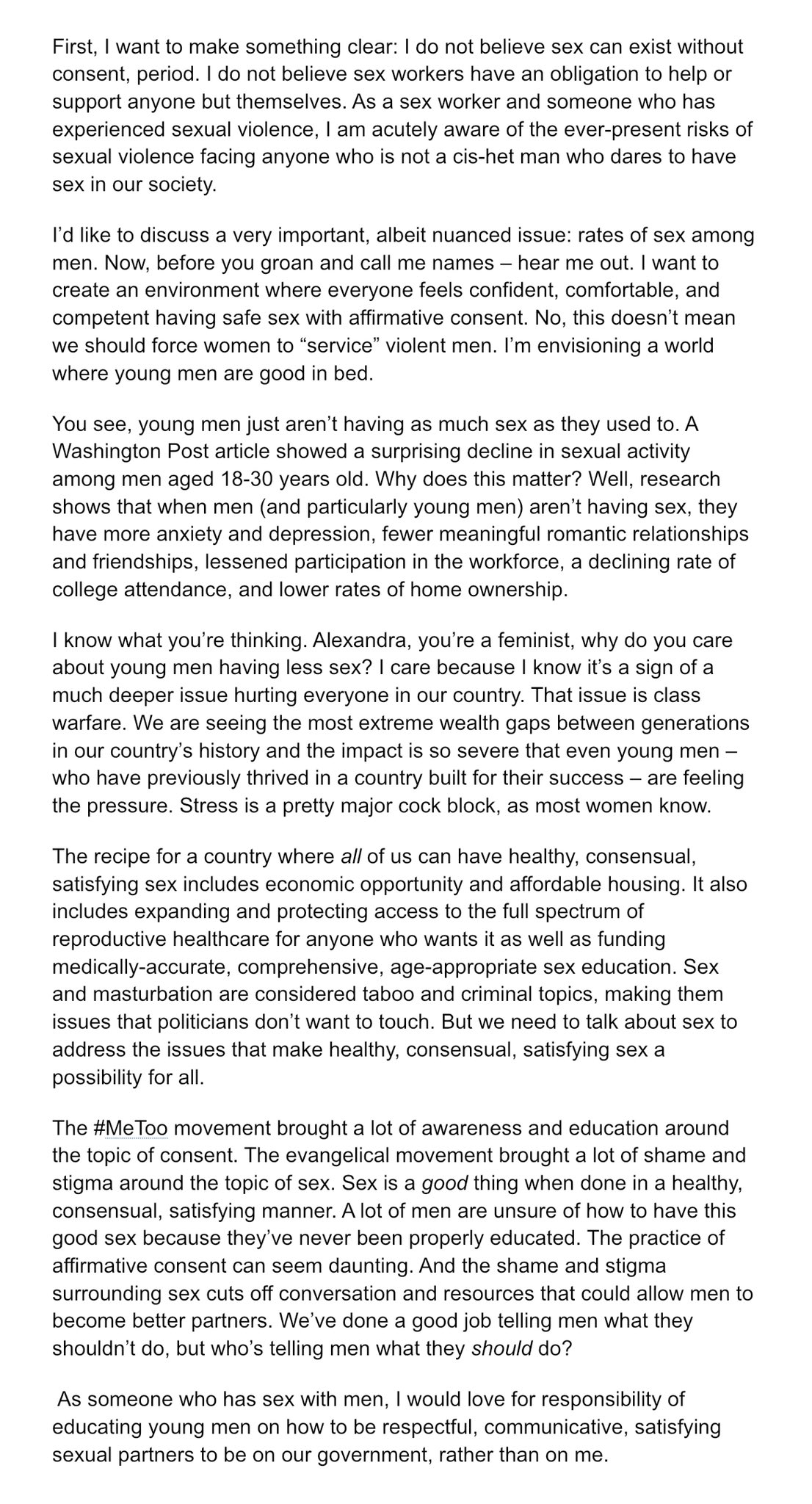
So, like I mentioned at the beginning of this essay, Hunt did issue an expanded statement. She referred to it as her “statement on the topic of young men having less sex,” and I will share that in full now.
I do believe this is a person who genuinely means well and I’m glad she introduced some of the economic drivers at play when it comes to the widespread misery in this nation. But at the same time, if you understand all of the enormous ways in which young people as a whole are struggling right now and choose to pick out how we can improve young people’s sex lives, I think you’re missing the point. Ultimately, I do agree that the government should be responsible for ensuring its citizens have received adequate sexual education and reproductive health care. But if you’re saying you want young people to have copious amounts of good sex, that is something you can’t legislate. And, to the last brief paragraph, there is not one way to be a satisfying sexual partner. The government can’t distribute a file on you to everyone you sleep with; there’s always going to be work involved for you to get what you want out of a sexual experience. I’m glad Alexandra Hunt has a class analysis and wants people to be safe and educated when it comes to sex, but it feels like the wrong conclusions are being drawn and this effort could perhaps be better used working towards other ends.
We have been told that sex is at the top of the pyramid of fulfillment and relationships. We have been told that men enjoy and *require* sex more than women inherently, biologically. And that if men don’t have their sexual needs met, they may become dangerous for that reason. (As an aside: People who don’t identify within the gender binary have long been left out of these conversations, which makes sense because they tend to be reductive and essentialist). These are lies. And we don’t do anyone any good when we reinforce those lies, even if we do so in an earnest if misguided attempt to make everyone’s lives better.
AND. This is infantilizing to men! And this is a tear I’ve been on since high school. The conceit of arguments like these is that men are beasts incapable of being anything but violent and destructive if they aren’t being waited on hand and foot. It doesn’t give men enough credit. Men can control themselves and regulate their emotions. And we need not blame sexual frustration – and, indirectly, women – when a man chooses to carry out an act of violence. Personally, if I were a man, I would feel insulted by the way we talk about men and sex. And what does it say to women? Are we to pretend the logical conclusion of this line of thinking is not state-sanctioned sexual servitude? It definitely sends the message that men’s problems are our collective responsibility. But women? If you’re having problems, you figure that out on your own. Oh, and you’re like the main source of labor for fixing those men problems we were just talking about. And again, a lot of these “problems” aren’t even problems for some men because people are different. For this specific case, SOME MEN DON’T WANNA HAVE SEX!
There are a lot of uncharitable readings of and responses to her, but I am under no illusions that Alexandra Hunt is the biggest political threat to women or workers. Notably, she is now posting more about the state of housing and the dangers of Airbnb, eliminating the tipped minimum wage, and election-related things. But I do believe this is worth discussing so that we can all better understand and support one another. It’s great that Alexandra Hunt has so much compassion for men who aren’t getting any. However, her missteps in suggesting how best to “solve” that illustrate that even self-proclaimed feminists can slip up and prioritize the desires (or perceived desires) of men above all else. But the response also shows that there are individuals and organizations who will call out harmful rhetoric like this from a number of different perspectives. And that gives me hope.


































































 farfaraway